
You've finally decided to try Brazilian Jiu-Jitsu.
You find a gym, open the class schedule, and discover that there are two different kinds of BJJ: Gi and No-Gi.
Now you're wondering whether you need a special uniform, whether one class is more difficult, and whether choosing the wrong one means you'll be completely lost.
The good news is that both styles teach Brazilian Jiu-Jitsu.
You don't need to understand all the differences before your first class.
But knowing a few basics will make it easier to choose a starting point.
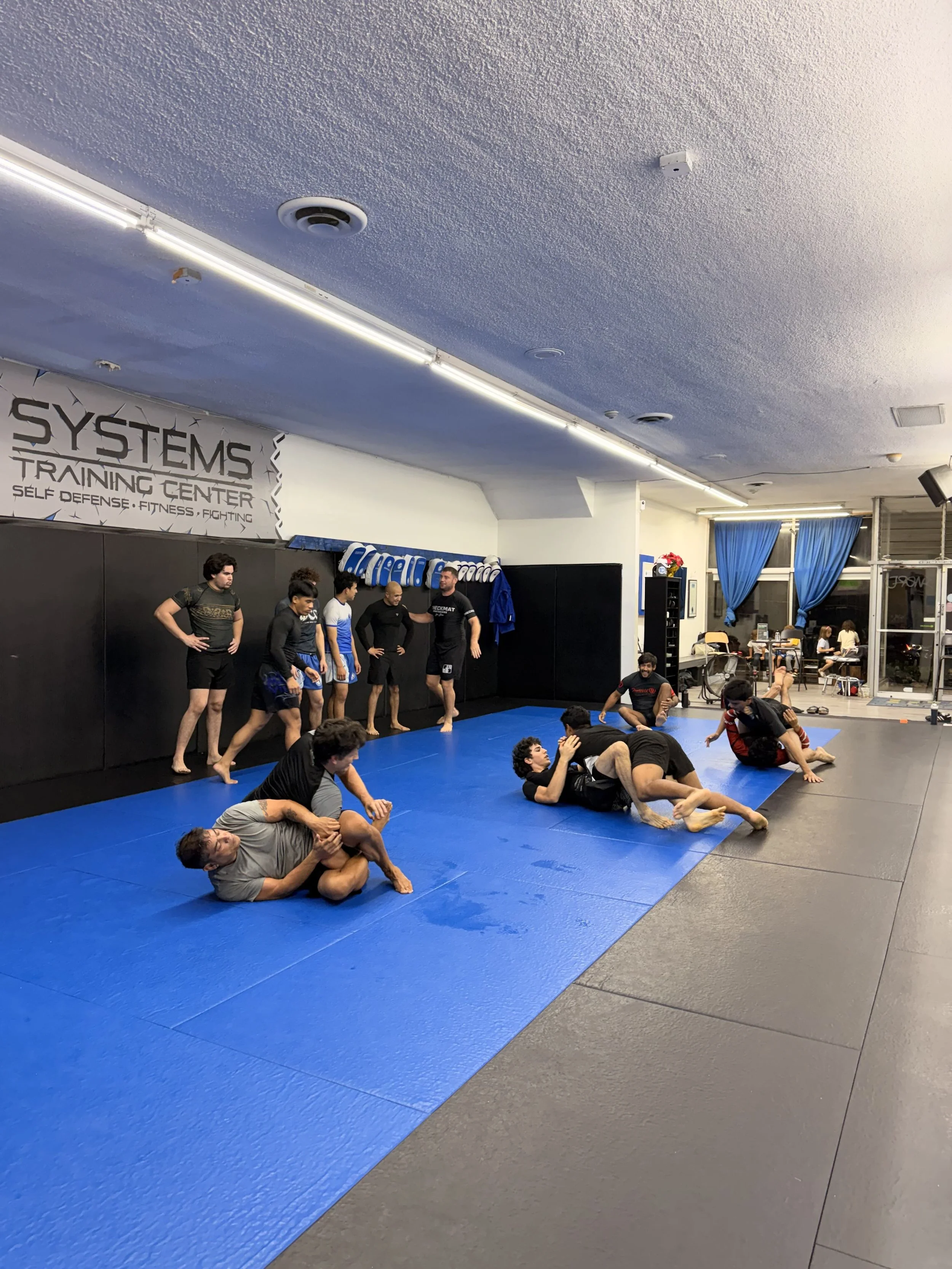
At Systems Training Center in Hawthorne, California, we offer both Gi and No-Gi Brazilian Jiu-Jitsu as part of our grappling program.
Here's how they compare.
What Is Gi Brazilian Jiu-Jitsu?
Gi BJJ is practiced in a traditional martial arts uniform consisting of a durable jacket, pants, and belt.
The Gi is more than clothing.
In this style of Jiu-Jitsu, students can grip parts of the uniform to control their training partner.
For example, you might grab a sleeve to control an arm, grip a collar to maintain position, or use the fabric to help execute a sweep or submission.
The uniform creates additional opportunities for control, but it also gives your partner additional ways to control you.
This introduces a large number of technical possibilities.
You'll learn how to manage grips, maintain posture, move efficiently, and recognize when a training partner is setting something up.
For many practitioners, that technical complexity is one of the most enjoyable aspects of Gi training.
What Is No-Gi Brazilian Jiu-Jitsu?
No-Gi BJJ is practiced without the traditional uniform.
Students generally wear fitted athletic clothing such as rash guards, grappling shorts, or leggings.
Instead of gripping a jacket or pants, you use body positioning and grips on your training partner's limbs, head, or torso.
Because there is no Gi fabric to hold onto, controlling someone can feel different.
You may find yourself relying more heavily on underhooks, wrist control, head positioning, body locks, and transitions between positions.
No-Gi also has strong connections with wrestling and submission grappling.
That does not mean No-Gi is the same as MMA.
In a standard No-Gi BJJ class, you're still practicing grappling rather than punches and kicks.
Is Gi or No-Gi Harder?
Neither is universally easier.
They simply present different challenges.
In Gi BJJ, an experienced training partner may use your clothing to slow you down, control your posture, or establish a submission.
In No-Gi, the lack of fabric grips can make certain positions more slippery and harder to maintain.
No-Gi training can sometimes feel faster because it's harder to hold certain grips, but the pace depends heavily on the students and the type of training.
Some beginners prefer Gi because the uniform offers clear grips to work with.
Others prefer No-Gi because they find the clothing more comfortable or the movement style more familiar.
You'll eventually discover which aspects of each style suit you.
Which Style Is Better for Beginners?
Both are legitimate starting points.
A more useful question is: Which class are you most likely to attend consistently?
If the best class for your schedule is Gi, start with Gi.
If No-Gi is more accessible, start with No-Gi.
The most important beginner skills exist in both styles.
You'll learn to:
Protect yourself in vulnerable positions
Control your posture and balance
Escape from underneath an opponent
Use leverage instead of relying entirely on strength
Understand dominant positions
Recognize and apply fundamental submissions
Communicate with training partners and tap appropriately
Those skills form the foundation of Brazilian Jiu-Jitsu regardless of what you're wearing.
Is Gi or No-Gi Better for Self-Defense?
Both can contribute useful skills.
Gi BJJ teaches you to manage grips and control an opponent using fabric, which can have some similarities to situations involving everyday clothing.
No-Gi develops grappling skills without relying on clothing grips, which may translate to situations where fabric is difficult to control.
But self-defense involves more than choosing a uniform.
Awareness, avoiding confrontation, making space, staying on your feet when possible, and safely escaping are important considerations.
Neither Gi nor No-Gi training alone prepares someone for every possible physical threat.
The value of BJJ is that you can practice controlling movement and responding to resistance in a structured environment.
What Should I Wear to a Gi or No-Gi Trial Class?
If you're attending a Gi class, you'll need a Jiu-Jitsu Gi and belt.
If you don't have one, contact the gym before your first class to ask about trial options and appropriate equipment.
For a No-Gi class, fitted athletic clothing is generally appropriate. A rash guard and grappling shorts are common choices.
Avoid loose clothing that can catch on someone's hands or feet, and avoid exposed zippers, pockets, jewelry, and anything that could scratch a training partner.
Cleanliness matters in both styles. Arrive in clean clothing, keep your nails trimmed, and do not train if you have a potentially contagious skin infection.
A few simple precautions make close-contact training safer and more comfortable for everyone.
Do I Need to Choose Gi or No-Gi Permanently?
Not at all.
Many Brazilian Jiu-Jitsu practitioners train in both.
Skills learned in one style often carry over to the other, even though some techniques and strategies differ.
Someone who primarily trains Gi may improve their ability to control positions without fabric grips by exploring No-Gi.
Someone who primarily trains No-Gi may discover new ways to control an opponent through Gi grips.
Learning both can broaden your understanding of the sport.
You don't need to make that decision immediately.
Start with one class, build some familiarity, and explore the other style when you're ready.
Where Can I Train Gi and No-Gi BJJ in the South Bay?
Systems Training Center offers Brazilian Jiu-Jitsu in Hawthorne, California, serving adults from El Segundo, Manhattan Beach, Redondo Beach, Hermosa Beach, Gardena, Lawndale, Inglewood, and nearby communities.
As a Checkmat-affiliated training center, we emphasize technical development, practical grappling skills, and continued improvement.
Whether you're completely new to BJJ or have previous experience, you can explore Gi and No-Gi training through our program.
The best way to determine which you prefer is to experience a class.
Try Gi or No-Gi Brazilian Jiu-Jitsu at Systems Training Center
Still deciding?
You don't need to arrive with the answer.
Contact us, tell us you're new to Brazilian Jiu-Jitsu, and we'll help you select an appropriate introductory class.
Systems Training Center
13040 Hawthorne Blvd, Hawthorne, CA 90250
(424) 269-1337
Book your free BJJ trial class and find your starting point.
Train Brazilian Jiu-Jitsu in Hawthorne
Systems Training Center has trained fighters and everyday members for over 12 years, including athletes who have competed in the UFC, Bellator and LFA. You'll learn from coaches who know how to teach total beginners, too. We're at 13040 Hawthorne Blvd, close to El Segundo, Torrance, Lawndale and Manhattan Beach.
Book your free trial Muay Thai class / Call 424-269-1337.